
Did you know that your stomach gets a brand new lining every few days just so it doesn’t digest itself? Or that there’s a planet made of diamond floating somewhere in our galaxy?
Science isn’t just about boring textbooks and complicated formulas. It’s the story of everything around us. From the tiniest atom to the largest black hole, the universe is packed with surprises that feel more like magic than reality.
In this article, we’ve collected 50 mind-blowing science facts that will make you say, “Wait, is that really true?” Whether you’re a student working on a project, a teacher looking for fun facts, or just someone who loves to learn, these interesting science facts will change how you see the world.
Let’s jump right in.
What Makes Science So Fascinating?
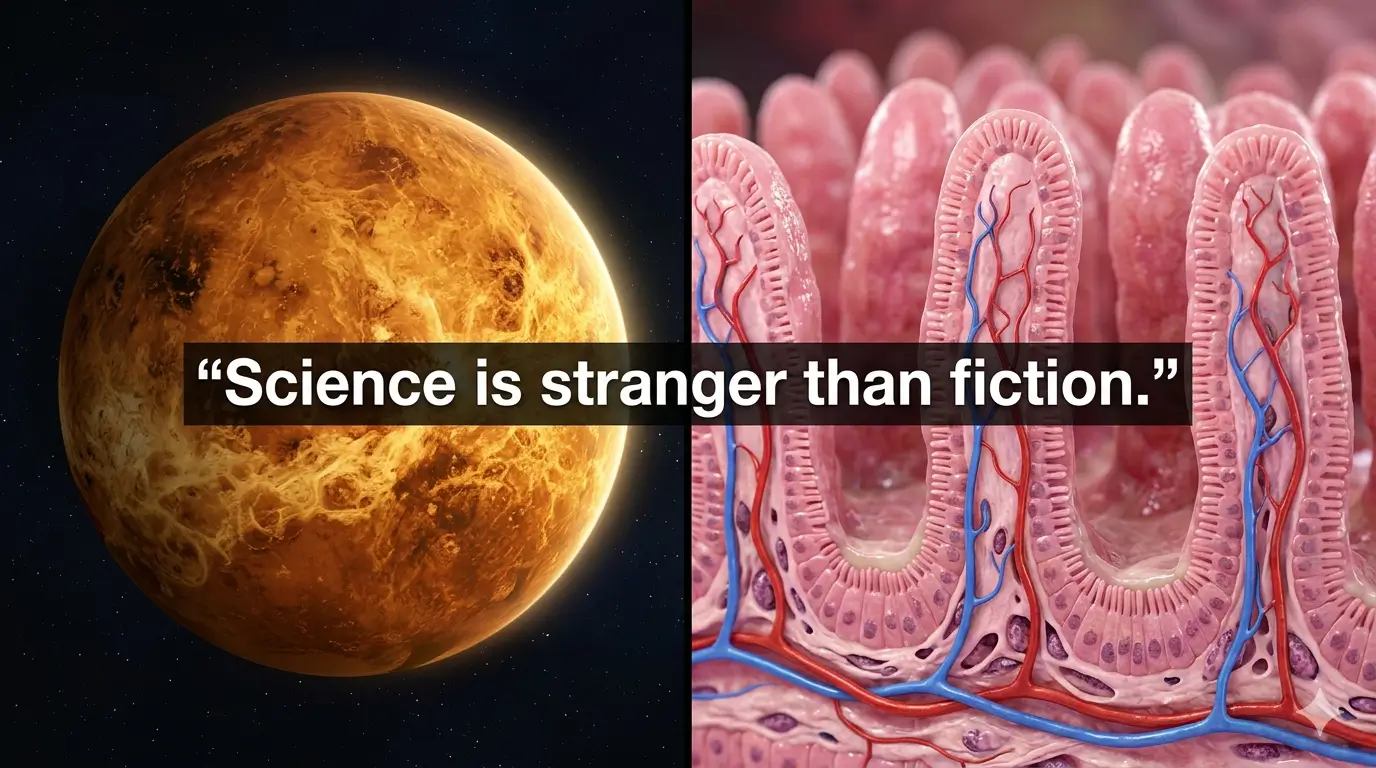
Science is fascinating because it constantly proves that reality is stranger than fiction. We grow up thinking we understand how things work. The sky is blue. Water is wet. Time moves forward.
But then science comes along and says: “Actually, your bones are stronger than steel. And there are more stars in space than grains of sand on every beach on Earth.”
These surprising science facts remind us how little we truly know. They spark curiosity. And curiosity is what led to every great discovery, from penicillin to the moon landing. Every science mystery we solve reveals ten more questions. That’s the beauty of it.
50 Mind-Blowing Science Facts You Probably Didn't Know
Space & Astronomy Facts
1. A Day on Venus Is Longer Than a Year on Venus
Venus spins incredibly slowly on its axis. It takes about 243 Earth days to complete just one rotation. But it orbits the sun much faster, taking only 225 Earth days. That means a single day on Venus (sunrise to sunrise) lasts longer than an entire Venus year. If you lived there, you’d celebrate a birthday before seeing a second sunrise.
2. There’s a Giant Cloud of Alcohol Floating in Space
Near the center of the Milky Way, astronomers found a massive cloud of ethyl alcohol. Don’t get excited—it’s not drinkable. This cloud contains enough alcohol to fill 400 trillion trillion pints of beer. It stretches across 463 billion kilometers. This is one of the weird science facts that sounds fake, but it’s 100% real.
3. One Spoonful of a Neutron Star Weighs a Billion Tons
Neutron stars are the crushed leftovers of exploded giant stars. They pack an entire star’s worth of mass into a ball only 20 kilometers wide. A single teaspoon of that material would weigh about 10 million tons on Earth. That’s heavier than Mount Everest. You couldn’t lift it. You couldn’t even move it.
4. Space Smells Like Seared Steak and Hot Metal
Astronauts report that after spacewalks, their suits smell like cooked beef, hot metal, and welding fumes. Scientists think this comes from dying stars or vibrating molecules. It’s one of those fascinating science discoveries that human senses wouldn’t normally experience. Space isn’t silent and empty. It has a smell.
Did You Know?
Footprints on the moon will stay there for millions of years because the moon has no wind or water to erase them.
5. The Sun Loses One Billion Kilograms Every Second
The sun burns hydrogen into helium through nuclear fusion. This process converts mass into energy. Every second, the sun loses about 1.5 billion kilograms of material. Don’t worry though. At this rate, the sun has only lost about 0.05% of its total mass over 4.5 billion years. It’s not going anywhere soon.
6. Olympus Mons on Mars Is Three Times Taller Than Everest
Mars has a volcano called Olympus Mons that stands 21.9 kilometers high. Mount Everest is only 8.8 kilometers above sea level. What’s even crazier? Olympus Mons is so wide that if you stood on its peak, the base would disappear below the horizon. You wouldn’t even realize you’re on a volcano.
7. There Are More Trees on Earth Than Stars in the Milky Way
Scientists estimate Earth has about 3 trillion trees. The Milky Way galaxy has roughly 100 to 400 billion stars. That means trees outnumber stars by almost 10 to 1. This is one of those amazing science facts that puts our planet’s scale into perspective. We’re living on a lush, green world in a dark universe.
Human Body Facts
8. Your Body Gives Off a Small Amount of Light
All humans glow. Seriously. We emit tiny amounts of visible light called biophotons. The glow is about 1,000 times weaker than what our eyes can see. It rises and falls with our daily rhythms, being brightest in the late afternoon. So yes, you literally shine.
9. Your Stomach Gets a New Lining Every Three Days
Your stomach acid is strong enough to dissolve metal. It’s powerful enough to burn a hole through your stomach wall. So how do you survive? Your stomach lining replaces itself every 72 hours. It’s constantly rebuilding to prevent digesting itself. That’s incredible science facts your biology textbook might skip.
10. Your Bones Are Stronger Than Steel
A block of bone the size of a matchbox can support 9 tons of weight. That’s four times stronger than concrete. Steel has a higher density, but pound for pound, human bone is stronger than many types of steel. No wonder our skeletons last a lifetime.
11. You Have as Many Bacteria Cells as Human Cells
For every human cell in your body, you carry about one bacterial cell. Most of these microbes live in your gut. They help digest food, fight infections, and even affect your mood. You’re not just a person. You’re a walking, talking ecosystem.
12. Your Brain Uses 20% of Your Body’s Oxygen
Your brain makes up only 2% of your body weight. Yet it demands 20% of your oxygen and blood flow. Even when you’re sleeping, your brain is working hard—cleaning itself, storing memories, and keeping you alive. That’s why staying hydrated and breathing fresh air makes such a difference.
Did You Know?
The human nose can remember 50,000 different scents. That’s better than most animals.
13. You Produce Enough Saliva in a Lifetime to Fill Two Swimming Pools
The average person makes between 0.75 and 1.5 liters of saliva daily. Over 70 years, that adds up to around 25,000 liters. An Olympic swimming pool holds about 2.5 million liters, so it’s closer to two small backyard pools. Still, that’s a shocking amount of spit.
Animal & Nature Facts
14. Octopuses Have Three Hearts and Blue Blood
Two hearts pump blood to the gills. The third pumps it to the rest of the body. Their blood is blue because it uses copper-based hemocyanin instead of iron-based hemoglobin. Copper works better in cold, low-oxygen environments. Octopuses are basically aliens living in our oceans.
15. A Group of Flamingos Is Called a “Flamboyance”
The name fits perfectly. Flamingos stand on one leg to conserve body heat. Their pink color comes from eating shrimp and algae packed with beta-carotene. And when they gather in large groups, it’s truly a flamboyant display. This is one of those science facts you didn’t know but will never forget.
16. Cows Have Best Friends and Get Stressed When Separated
Research shows cows form close bonds with specific herd members. When separated from their best friend, their heart rate rises, and stress hormones increase. Some farmers now keep cows in smaller, stable groups to improve their mental health. Happy cows produce more milk.
17. A Mantis Shrimp Punch Can Break Aquarium Glass
Mantis shrimp are small but terrifying. They hunt using club-like limbs that accelerate faster than a .22 caliber bullet. The impact creates cavitation bubbles that collapse with intense heat and light. In captivity, they’ve shattered thick glass aquariums. Handle with care.
18. Tardigrades Can Survive Outer Space
Water bears (tardigrades) are microscopic animals that survive extreme heat, cold, radiation, and even the vacuum of space. They achieve this by entering a death-like state called cryptobiosis, drying out and waiting for better conditions. Some have woken up after 30 years. They’re practically immortal.
| Animal | Superpower |
|---|---|
| Tardigrade | Survives space radiation |
| Mantis Shrimp | Punches at bullet speed |
| Octopus | Three hearts, blue blood |
| Flamingo | Color changes from diet |
Earth & Ocean Facts
19. The Deepest Part of the Ocean Is Darker and Colder Than Space
The Mariana Trench’s Challenger Deep is nearly 11 kilometers down. Sunlight never reaches it. The pressure is 1,100 times greater than at sea level. Yet bizarre fish and giant amoebas live there. We know more about Mars’ surface than these trenches.
20. There’s a Hidden Ocean Beneath Earth’s Crust
Deep underground, about 400 kilometers down, a blue rock called ringwoodite holds massive amounts of water. Scientists estimate this hidden reservoir contains three times more water than all surface oceans combined. It’s not liquid water—it’s trapped inside the crystal structure.
21. Lightning Strikes Earth 8.6 Million Times Per Day
That’s about 100 strikes per second. Each bolt heats the air to 30,000°C—five times hotter than the sun’s surface. The sudden expansion creates thunder. And no, lightning can strike the same place twice. The Empire State Building gets hit about 25 times per year.
22. The Earth’s Core Is as Hot as the Sun’s Surface
Our planet’s inner core reaches temperatures around 5,500°C. The sun’s surface is about 5,500°C to 6,000°C. Luckily, the core is 6,000 kilometers below our feet. Otherwise, we’d be cooked. This heat drives volcanoes, earthquakes, and the magnetic field protecting us from solar wind.
Did You Know?
The Pacific Ocean covers 30% of Earth’s surface. That’s larger than all land combined.
23. There’s a Lake That Turns Animals Into Stone
Lake Natron in Tanzania has a pH as high as 12. That’s extremely alkaline, like ammonia. Birds and bats that fall in don’t just decompose. They calcify. The water preserves them in eerie, stone-like statues. It’s beautiful, deadly, and entirely natural.
24. Sand Dunes Can Sing
In deserts worldwide, certain sand dunes produce low-frequency humming or booming sounds when avalanches occur. The noise can reach 105 decibels and last minutes. Scientists still debate the exact cause, but it involves grain size, humidity, and movement speed.
Technology & Physics Facts
25. The First Computer Mouse Was Made of Wood
In 1964, Doug Engelbart built the first mouse using a wooden block, one circuit board, and two metal wheels. He called it a “mouse” because the cord looked like a tail. The wood came from a local hobby shop. Today’s gaming mice owe everything to that humble block.
26. Every Year, You Breathe One Kilogram of Dead Skin
You shed about 500 million skin cells daily. That’s 1.5 pounds annually. Those tiny flakes become airborne dust. A significant portion of the dust in your home is old, dead skin. And you’re breathing some of it right now. Don’t worry—it’s harmless.
27. CAPTCHA Tests Are Digitizing Old Books
Every time you type those squiggly letters, you help computers learn to read. Google’s reCAPTCHA system shows you scanned words from old books that computers couldn’t recognize. Your correct entry gets added to the database. Millions of people have already helped digitize thousands of books.
28. The First Hard Drive Weighed Over a Ton
IBM introduced the first hard drive in 1956. It stored 5 megabytes—enough for one low-quality song today. The device weighed over a ton and had to be moved with a forklift. Now, a 1-terabyte microSD card is smaller than your fingernail.
29. Glass Is Actually a Liquid That Flows Extremely Slowly
Strictly speaking, glass is an amorphous solid. But over incredibly long times, it behaves like a supercooled liquid. Ancient church windows are thicker at the bottom. Some people claim this proves glass flows. The truth? Medieval glassmakers made uneven panes. Still, glass’s molecular structure is disordered like a liquid.
30. Time Moves Faster at the Top of a Skyscraper
Einstein’s theory of relativity predicts that gravity affects time. The stronger the gravity, the slower time passes. So time moves slightly faster on the top floor of a tall building than on the ground floor. GPS satellites must correct for this every millisecond, or your phone’s maps would be off by kilometers.
Chemistry & Biology Facts
31. Your DNA Can Stretch to the Sun and Back 600 Times
If you unwound all the DNA in your body and connected it end to end, the strand would stretch 10 billion miles. That’s enough to go from Earth to the sun and back 600 times. All that information fits into cells too small to see. This is one of the most amazing science facts about your own body.
32. Hot Water Freezes Faster Than Cold Water
It’s called the Mpemba effect. Under certain conditions, hot water freezes more quickly than cold water. Scientists still debate why. Possible explanations include evaporation, convection currents, and supercooling. Aristotle first noted it 2,000 years ago. We still don’t fully understand it.
33. Bananas Are Slightly Radioactive
Bananas are rich in potassium. A small fraction of that potassium is the radioactive isotope potassium-40. Your body handles it fine. You’d need to eat 10 million bananas at once to die from radiation poisoning. Still, geiger counters can detect a banana from across a room.
34. A Single Teaspoon of Honey Is the Life’s Work of 12 Bees
A honeybee visits 50 to 100 flowers per trip. It takes about 550 bees flying 50,000 kilometers to produce 450 grams of honey. That means the honey on your toast represents thousands of miles of flight and millions of flower visits. Never waste honey.
35. The Axolotl Can Regrow Its Brain, Heart, and Limbs
This Mexican salamander never grows up. It stays in its juvenile form forever. If it loses a leg, it grows back perfectly. If you damage its spinal cord, it heals. Even part of its brain regrows. Scientists study axolotls hoping to unlock human regeneration.
Did You Know?
The same chemical that makes blueberries blue also makes flamingos pink. It’s called anthocyanin.
36. Trees Talk to Each Other Through Underground Fungal Networks
Forests have a “Wood Wide Web.” Trees use fungal networks to share water, carbon, and nutrients. Older trees feed baby saplings. Sick trees receive help. Trees even warn neighbors about insect attacks. Forests aren’t collections of individuals. They’re single, intelligent communities.
Environment & Psychology Facts
37. Lightning Creates a Type of Glass Called Fulgurite
When lightning strikes sand, the extreme heat fuses silica into hollow, branching tubes of glass. These “fossilized lightning” structures are called fulgurite. They look like twisted, brittle tree roots. Some fulgurites stretch several meters underground.
38. The Air in Your Room Is Mostly Argon and Nitrogen
Oxygen makes up only 21% of Earth’s atmosphere. The rest is 78% nitrogen and 0.93% argon. Carbon dioxide is a tiny 0.04%. You’re breathing mostly nitrogen right now. It doesn’t hurt you. It just passes in and out.
39. Bamboo Can Grow a Meter in One Day
Certain bamboo species hold the record for fastest growing plant. Under ideal conditions, they shoot up 91 centimeters (35 inches) in 24 hours. You can literally watch bamboo grow if you sit long enough. It reaches full height in just 2 to 3 months.
40. Your Brain Tricks You Into Seeing Colors That Aren’t There
Magenta doesn’t exist in the light spectrum. When you see magenta, your eyes detect red and blue light but no green. Your brain invents magenta to fill the gap. It’s a “color” your mind creates. The same happens with some shades of pink.
41. You Forget 90% of Your Dreams Within 10 Minutes
Most people have 4 to 6 dreams per night. But unless you wake up during REM sleep or immediately write down details, 90% vanish within 10 minutes. Within an hour, you’ve lost almost everything. Those fragments you remember? They’re the final echoes.
42. Your Phone’s Screen Is Dirtier Than a Toilet Seat
Studies show the average smartphone screen hosts 10 times more bacteria than a toilet seat. Why? Toilets get cleaned. Phones go everywhere—bathrooms, kitchens, gyms. They also generate heat, which bacteria love. Clean your phone daily. Seriously.
| Fact Category | Example |
|---|---|
| Space | Venus day longer than year |
| Human Body | Stomach lining renews every 3 days |
| Animals | Octopuses have 3 hearts |
| Earth | Hidden ocean underground |
| Technology | First computer mouse was wooden |
43. Some People Can See 100 Million Colors
Most humans have three types of color-detecting cone cells. That lets us see about 1 million colors. But a rare condition called tetrachromacy gives some women four cones. They see subtle differences invisible to others. A simple leaf looks like a kaleidoscope.
44. Your Brain Can’t Feel Pain
Your brain processes pain signals from everywhere else. But it has no pain receptors itself. Neurosurgeons can operate on awake patients without causing brain pain. Patients feel the scalp incision. After that, they feel nothing inside. You can poke a brain, and it won’t hurt.
45. There Are More Possible Chess Games Than Atoms in the Universe
The number of unique chess games is around 10^120. Scientists estimate the observable universe contains about 10^80 atoms. That means chess is exponentially more complex than everything physical in existence. No computer will ever solve chess.
46. A Jellyfish Is 95% Water
If you leave a jellyfish on a hot rock, it nearly disappears. That remaining 5% is the structure holding everything together. Jellyfish have no brains, hearts, or bones. They’ve survived 500 million years without any of those things.
47. The Eiffel Tower Grows Taller in Summer
Heat causes metal to expand. On hot days, the Eiffel Tower’s iron structure expands by up to 15 centimeters (6 inches). When winter comes, it shrinks back. The tower also leans slightly away from the sun due to uneven heating.
48. Caffeine Doesn’t Actually Give You Energy
Caffeine blocks adenosine, a chemical that makes you feel tired. Your body still has the same amount of energy. Caffeine just hides the fatigue signal. That’s why you crash when it wears off. The adenosine floods back all at once.
49. Wombats Poop Cubes
Wombats are the only animals that produce cubic feces. Their intestines have elastic sections that compress the poop into rough squares. They stack these cubes to mark territory. The cubes don’t roll away. Evolution really solves problems in weird ways.
50. You Are Made of Star Dust
Every atom in your body heavier than hydrogen and helium was forged inside a star that exploded billions of years ago. The iron in your blood. The calcium in your bones. The oxygen you breathe. You aren’t just living on Earth. You are literally made of exploded stars.
Did You Know?
The human body contains enough carbon to make 900 pencils.
The Science Behind These Amazing Facts
How do scientists discover and verify these surprising science facts?
It starts with curiosity. A scientist notices something strange—like hot water freezing faster—and asks “why?” They form a hypothesis, design experiments, and collect data.
Then comes peer review. Other experts check the work for mistakes. They repeat the experiments. If multiple labs get the same result, the fact becomes accepted.
Modern tools make this possible. Telescopes see back to the Big Bang. Microscopes watch individual molecules. Particle colliders smash atoms together. Even citizen scientists help, like those solving CAPTCHA or identifying galaxies online.
Every fascinating science discovery goes through this filter. That’s why science is trustworthy. It’s not about belief. It’s about evidence that anyone can test.
Why Learning Science Facts Matters
You might wonder: why memorize random facts about wombat poop or Venusian days?
Here’s why:
For students: These facts make learning fun. A student who hears that octopuses have three hearts wants to learn more. One fun fact leads to a lifelong interest in biology.
For adults: Science facts challenge assumptions. They remind you that reality is stranger than fiction. That humility makes you smarter. You stop assuming you know everything.
For everyone: Science connects us. We’re all made of star dust. We all share bacteria. We all live on one tiny planet orbiting one ordinary star. That perspective matters.
Plus, science facts for students build critical thinking. When you learn how scientists discover truth, you spot misinformation faster. That’s a superpower in today’s world.
Frequently Asked Questions (FAQ)
What is the most mind-blowing science fact?
That depends on who you ask. Many people vote for the fact that we’re made of star dust. Others choose the hidden ocean beneath Earth’s crust. But the fact that your DNA could stretch to the sun and back 600 times is a strong contender. It makes you realize how much information fits inside something invisible.
What are some interesting science facts for students?
Students love animal facts. The mantis shrimp’s super-powered punch. Tardigrades surviving space. Octopuses with three hearts. Space facts also work well—like the diamond planet or the alcohol cloud. Keep them weird, visual, and short. Students remember what surprises them.
Why is science important in daily life?
Science explains why ice floats (density anomaly), why your coffee cools (heat transfer), and why you see blue sky (Rayleigh scattering). It gives you medicine, phones, and airplanes. Even cooking is chemistry. You use science every second without thinking about it. Understanding it makes you a better problem-solver.
How do scientists discover new facts?
They follow the scientific method. Observe something. Ask a question. Form a hypothesis. Test it with experiments. Analyze data. Share results for peer review. Other scientists replicate the work. Over time, a fact becomes established if experiments consistently support it. It’s slow, careful, and self-correcting.
What is the strangest fact in science?
The Mpemba effect (hot water freezing faster) is famously strange because it violates common sense. Wombat cube poop is strange because it’s so specific. And quantum entanglement—where two particles affect each other instantly across any distance—is so strange that Einstein called it “spooky action at a distance.” Reality is weird.
Conclusion
We’ve traveled from the center of neutron stars to the deepest ocean trenches. We’ve learned that flamingos are flamboyant, trees talk to each other, and your brain invents colors that don’t exist.
These 50 mind-blowing science facts prove one thing: the universe is far more incredible than we imagine. Every day, scientists uncover new science mysteries that rewrite the textbooks. What we know today might seem simple tomorrow.
So stay curious. Question everything. Read the latest science discoveries and explore future technology trends. Learn about space exploration facts and the amazing inventions happening right now. Share these facts with friends. Talk about them at dinner. Let science make your world bigger, weirder, and more wonderful.
What fact surprised you the most? Drop a comment below. And if you enjoyed this, check out our articles on scientific breakthroughs and space exploration facts next. There’s always more to discover.

You must be logged in to post a comment.