
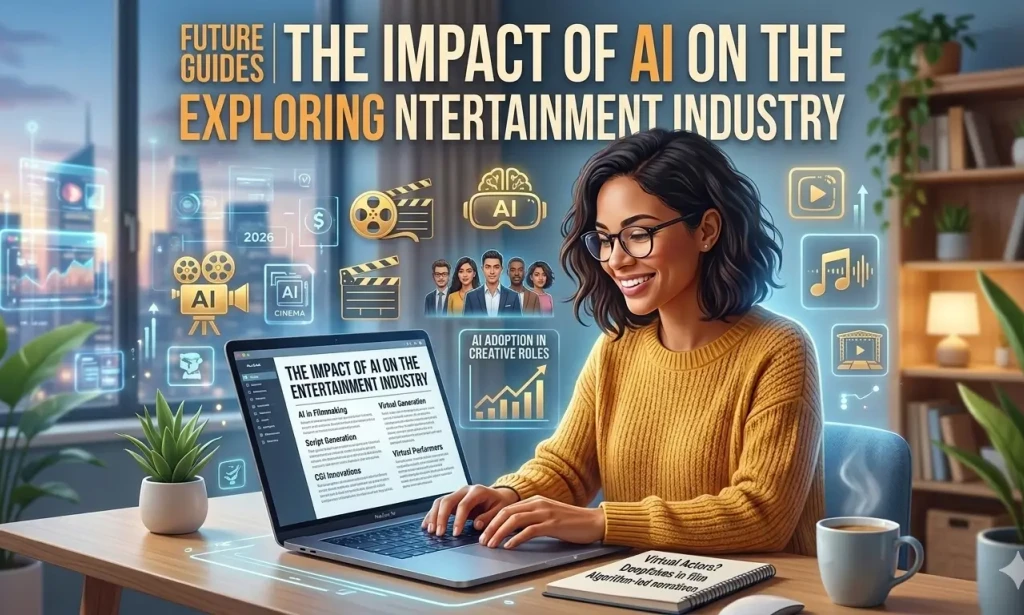
Artificial intelligence is no longer a futuristic concept in entertainment—it is already changing how movies are made, how music is produced, how games are designed, and how audiences consume content. From AI-generated visuals in film production to personalized recommendations on streaming platforms, the entertainment industry is going through one of its biggest transformations since the rise of the internet. Studios, creators, and audiences are all adapting to a new era where machines can assist creativity, automate workflows, and reshape business models.
Recent reports suggest AI could reduce costs in media production by up to 10% overall and as much as 30% in TV and film workflows, especially in editing, planning, and visual effects. At the same time, debates around copyright, deepfakes, jobs, and originality are becoming more intense. The real question is not whether AI will affect entertainment—it already has. The question is how far it will go.
Understanding AI in Entertainment
Artificial intelligence in entertainment refers to software systems that can analyze data, generate content, automate repetitive tasks, and even mimic human voices or visuals. Think of AI as a creative assistant with super-speed rather than a full replacement for human imagination. It can help write story drafts, enhance images, edit video scenes, recommend songs, or create realistic game characters. That is why studios and creators are investing heavily in AI tools.
Why is 2026 a turning point? Because the technology is now moving from experimental demos to real business use. Major film studios are testing AI workflows, music platforms are dealing with AI-generated songs, and gaming companies are integrating generative AI into development pipelines. According to McKinsey, entertainment executives are actively exploring how AI can reshape production models and cost structures.
The entertainment business has always embraced technology. Black-and-white films became color movies. CDs became streaming apps. Cable TV became on-demand platforms. AI is simply the next giant wave—but unlike previous shifts, it touches both production and creativity itself. That is why its impact feels bigger, faster, and more controversial.
AI in Film and Television
The film and TV industry is one of the clearest examples of AI disruption. Traditionally, creating a movie involved expensive teams, long timelines, and manual workflows. AI now speeds up many of those stages. In pre-production, AI tools can analyze scripts, estimate budgets, suggest filming schedules, and even generate concept art within minutes. What once took weeks can sometimes happen in hours.
In post-production, AI helps with video editing, color correction, noise removal, dubbing, subtitle generation, and visual effects. This does not mean editors disappear. It means editors can spend more time making creative decisions instead of handling repetitive tasks. Morgan Stanley estimates significant cost reductions are possible across media production because of these efficiency gains.
One of the most debated trends is digital actors and voice cloning. A recent film used an authorized AI recreation of actor Val Kilmer with estate approval and SAG-AFTRA compliance. This shows how AI can preserve performances, but it also raises serious consent and ownership questions. If someone’s face or voice can live forever digitally, who controls it? The answer will shape Hollywood’s future.
AI in the Music Industry
The music world has been shaken by AI faster than many expected. AI tools can generate melodies, write lyrics, create beats, master tracks, and imitate vocal styles. Independent artists now have access to tools once reserved for expensive studios. That lowers barriers and opens doors for new talent.
At the same time, AI-generated songs are competing for attention. Reports in 2026 highlight growing concern over synthetic artists, streaming royalties, and chart manipulation. AI-generated music projects have already sparked public debate about authenticity and fairness.
Streaming services also benefit from AI through personalization. Ever wondered how Spotify or YouTube Music seems to know your mood? AI analyzes listening habits, skips, repeats, and timing to recommend songs with eerie accuracy. This improves user engagement and keeps listeners subscribed.
| AI Benefit in Music | Real Impact |
|---|---|
| Song generation | Faster demos and experimentation |
| Mixing/mastering | Lower production cost |
| Recommendations | Better user retention |
| Voice synthesis | New creative formats |
| Data analytics | Smarter marketing campaigns |
Still, copyright remains the storm cloud overhead. If an AI model learns from thousands of copyrighted songs, who should be paid? Labels, artists, and AI companies are battling over that answer worldwide.
AI in Gaming
Gaming may become the biggest AI winner of all. Why? Because games are already interactive, digital, and data-rich. AI fits naturally into that environment. It can power smarter enemies, realistic companions, dynamic dialogue, and worlds that adapt to player behavior.
Imagine a role-playing game where non-player characters remember your actions, hold natural conversations, and respond emotionally. That experience feels more alive than scripted dialogue trees. Some industry voices believe generative AI will radically improve immersion and customization in future games.
AI also helps developers build environments faster. Instead of manually designing every forest, city, or dungeon, teams can use procedural AI systems to generate assets and layouts. Smaller studios gain an advantage because they can create bigger experiences with fewer resources.
There is another hidden benefit: customer support. AI chatbots in gaming ecosystems can solve player issues quickly, reducing wait times significantly according to industry reports. For players, that means less frustration. For companies, it means lower support costs and happier communities.
AI and Streaming Platforms
Streaming platforms like Netflix, Disney+, YouTube, and Spotify run on data. AI is the engine behind much of that data-driven experience. Recommendation systems decide what appears on your homepage, what trailer auto-plays, and which content you are most likely to watch next.
This is powerful because attention is the real currency of entertainment. With thousands of movies, shows, and songs available, viewers need guidance. AI solves that discovery problem by matching users with content they are likely to enjoy. If recommendations improve by even a small percentage, subscription revenue can rise massively.
AI also helps predict churn—the likelihood that a user will cancel. Platforms analyze behavior like reduced watch time or inactivity, then push targeted promotions or better suggestions. That makes AI not just a creative tool, but a revenue machine.
Some companies are even testing AI-generated trailers, thumbnails, and localized dubbing. Instead of one trailer for all viewers, future systems may generate multiple versions depending on audience interests. Sports fan? You get action scenes. Romance fan? You get character drama. AI turns marketing into precision targeting.
Risks and Ethical Concerns
Every gold rush has shadows, and AI is no different. One major concern is job displacement. If AI can edit clips, generate art, write rough scripts, or produce music drafts, some roles may shrink or change. But history suggests technology often transforms jobs rather than simply erasing them. New positions emerge in prompt design, AI supervision, rights management, and hybrid creative workflows.
Deepfakes are another serious issue. AI can create fake celebrity videos, cloned voices, and misleading performances. That threatens trust in media. If audiences can’t tell what is real, reputation damage becomes easier and misinformation spreads faster.
There is also the emotional concern of authenticity. Many fans want art created by humans because human struggle, joy, heartbreak, and experience give art meaning. A song is more than sound waves. A film is more than pixels. It carries lived emotion. AI can mimic style, but whether it can replicate soul remains a hot debate.
Regulation is now accelerating. New laws in places like California require explicit consent for digital replicas of performers. That signals governments are stepping in as technology outruns old rules.
Future of Entertainment with AI
The future is unlikely to be “AI replaces humans.” A more realistic outcome is human + AI collaboration. Directors may use AI for planning shots. Musicians may use AI for arrangement ideas. Game studios may use AI for dialogue generation under human oversight. Creators who learn to use these tools may become faster and more competitive.
AI may also unlock brand-new forms of entertainment. Personalized movies where storylines adapt to viewer choices. Music generated live to match your workout pace. Games that create endless narratives unique to each player. Entertainment could become less static and more responsive.
Audience reaction will matter. Some people will love AI-powered experiences. Others will seek handcrafted, human-made art as a premium category. That could split the market into fast scalable AI content and slower prestige human creations.
The biggest winners may be creators who blend both worlds—using AI for efficiency while protecting originality and emotional depth. Machines can accelerate creation, but humans still define meaning.
Conclusion
The impact of AI on the entertainment industry is massive, immediate, and still unfolding. It is lowering production costs, speeding up workflows, personalizing experiences, and enabling new creative possibilities across film, music, gaming, and streaming. At the same time, it raises urgent questions about jobs, consent, copyright, and authenticity.
Entertainment has always evolved through technology, but AI is different because it enters the creative core itself. It can help imagine, compose, edit, and perform. That power makes it exciting and unsettling at the same time. The future belongs not to machines alone, but to creators who know how to use them wisely.
FAQs
1. How is AI changing the film industry?
AI helps with script analysis, editing, dubbing, VFX, scheduling, and even digital recreations of actors.
2. Can AI replace musicians?
AI can assist music creation, but human emotion, identity, and originality still matter greatly to audiences.
3. Why do streaming platforms use AI?
They use AI for recommendations, audience retention, targeted marketing, and content discovery.
4. Is AI good for gaming?
Yes, AI can improve NPC behavior, procedural worlds, support systems, and personalized gameplay.
5. What is the biggest risk of AI in entertainment?
Major risks include deepfakes, copyright disputes, job disruption, and loss of trust in media.

You must be logged in to post a comment.